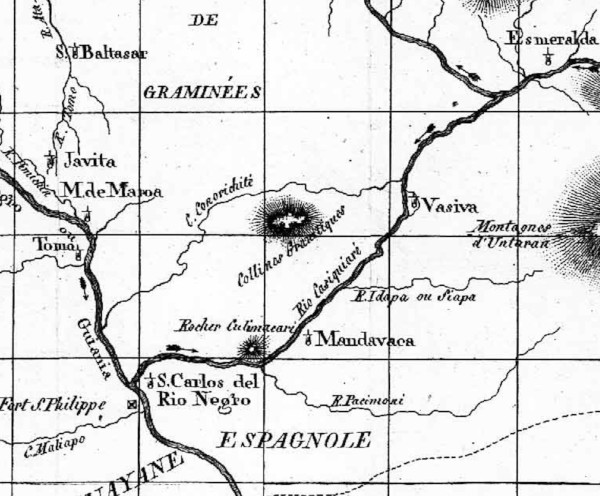
"The two writers hired a boat and a guide to take them 1,000 miles up the Orinoco and along the Casiquiare to the Rio Negro, which flows into the Amazon." - University of Chicago Press (in 2026 a 404).
"The Casiquiare is unique. There is no other river like it on the planet. Somehow it manages to unite the two river systems of the Orinoco and the Amazon that should, by rights, be entirely separate, and the Casiquiare performs the astonishing feat of flowing up and over the watershed that divides them. Richard Starks and Miriam Murcutt travelled along the Casiquiare at the behest of the Royal Geographical Society-and in the footsteps of exploring greats like Alexander von Humboldt and Aimé Bonpland-to gather information about the river and the fierce Yanomani tribe that still maintains its austere and primitive lifestyle in the region." - authors' website
"The Casiquiare river is a distributary of the upper Orinoco flowing southward into the Rio Negro, in Venezuela, South America. As such, it forms a unique natural canal between the Orinoco and Amazon river systems. It is the world's largest river of the kind that links two major river systems, a so-called bifurcation. The area forms a water divide, more dramatically at regional flood stage.
"The Yanomami are a group of approximately 35,000 indigenous people who live in some 200-250 villages in the Amazon rainforest on the border between Venezuela and Brazil."

2 - Casiquiare - connects the Orinoco and the Amazon (via Rio Tinto)
6 - Royal Geographic Society of London - founded 1830
9 - the Society's library of 150,000 books and map room with nearly 1 million maps
10 - Thomas Baines - artist on Livingstone's 1858 Zambezi expedition
16 - pirata - unmarked taxis in Venezuela
18 - Caracas
18 - Guaicaipuro market
20 - Pat Robertson - calls on the CIA to kill Hugo Chavez
22 - hatos - large ranches
22 - in Venezuela, 75% land owned by 5% people
28 - Samariado - end of the road, beyond are rapids that mark the beginning of the upper Orinoco
31 - Iguana - boat for the 1000 mile trip ahead
39 - Columbus third trip in 1493 - reaches the mouth of the Orinoco
39 - in 1595 - Sir Walter Raleigh - travels 300 miles up the Orinoco
42 - in 1744 - Father Manuel Roman - travels the Casiquiare
47 - in 1800 - von Humboldt travels the Casiquiare
54 - curripaco tribe (wakuenai)
... https://en.wikipedia.org/wiki/Baniwa
... https://es.wikipedia.org/wiki/Pueblo_kurripako
54 - yucca and flat bread - casabe
... https://es.wikipedia.org/wiki/Casabe_de_yuca
66 - Yanomami
68 - Yopo
68 - mirohiro
81 - wabu fruit
93 - Christian missionaries
96 - warned about FARC
97 - shabonos - circular structures in Yanomani villages
102 - pata - headman
104 - curiara - dugout canoe
108 - Casiquiare's source - split from Orinoco
109 - bifurcations (vs confluence)
110 - distributaries
114 - boto - freshwater dolphin
120 - arepas - Venezuelan specialty
140 - zancudos
140 - jejenes
158 - kingfisher
159 - manaca tree - pick berries
163 - yucata de manaca
163 - passenger - the Casiquiare sometimes changes direction (it doesn't)
164 - Humboldt - river as a "natural canal"
165 - Lucho - boat captain, Casiquiare always flows in one direction
171 - Momoni island
172 - árboles de caucho - rubber trees
177 - upper Orinoco - Casiquiare Biosphere Preserve
178 - garimpeiros / illegal miners
181 - traditional five-point face piercing
190 - consuming a smoothies with cremated ashes of deceased - endocannibalism as Yanomani tradition
194 - Culimacre rock
195 - meeting of Rio Guainia and the Casiquaire - form Rio Tinto
... https://es.wikipedia.org/wiki/R%C3%ADo_Negro_(Amazonas)
199 - decide to have lunch in San Felipe, Columbia ...
... https://es.wikipedia.org/wiki/San_Felipe_(Guain%C3%ADa)
205 - FARC
219 - motorcycle instructor - "dress for an accident"
226 - 1998 - FARC kidnapped ~7,500 people (mostly Columbian, but included 32 Americans)
{ The not getting kidnapped part and the reflection afterwards on taking travel risks is more than I expected from this river book }
238 - crows - can count to three, more than three is "many" as illustrated with a story of the farmer and a crow
146 / 147 - of film critic Dorothy Parker - "Parker once claimed she was so drunk that when she fell over she missed the floor."
196 - "Of course, at no time does it run uphill. Instead, the bed of the upper Orinoco has been slowly rising - elevated by thick deposits brought down from its source - so now it is a few feet higher than the bed of the Casiquiare. The watershed - the high ground that separates the Orinoco from the Amazon - is therefore right there, at the bifurcation. The Orinoco sweeps up to that watershed - the point at which each drop of water must decide whether to stay in the Orinoco and head for the Caribbean, or opt for the Casiquiare and go for the South Atlantic - and simply tips some of its water over the edge."

